To stop myself from getting stuck in a never ending spiral of rabbit holes and unable to settle on which particular one to follow, I decided to flesh out one of my more recent fascinations. Specifically Pōtae Taua | Mourning Caps.
Up until the end of last year I hadn’t heard of pōtae taua. In fact if I hadn’t fallen in love with my friend Byllie-Jean’s copy of Māori Bird Lore by Murdoch Riley, I likely never would have.
The sentence that caught my eye and was the catalyst for this research was simple enough:
“Bird feathers were a valued commodity, used to adorn the hair, to cover widow’s mourning caps, to ornament cloaks, weapons, toys, canoes etc.” (Riley, 2001, p. 8).
With no further information provided, I immediately assumed that this type of pōtae was popular post Pākehā contact. To me, the idea of a hat, specifically a black hat, set aside for a period of mourning sounded almost Victorian to me. However, a quick Google search pointed to these pōtae being around prior to the arrival of Pākehā to Aotearoa | New Zealand.
In Banks & Beaglehole’s ‘The Endeavour Journal of Joseph Banks 17-68-1771’ there is what is believed to be a sighting of pōtae taua worn by both wāhine and tāne. It was during his time whilst exploring Tōtaranui | Queen Charlotte Sound in Te Waipounamu | The South Island that he recorded the following:
“…besides the common dress some of these people wore on their heads round Caps made of birds feathers which were far from being unbecoming.” (Banks & Beaglehole, 1969, p. 247).
Within the footnotes of his journal, it mentions how Cook goes on to describe the feathers as being black. Sir Peter Buck, author of ‘The Coming of the Māori’, believes that these caps “…were a form of mourning cap, worn by all women and some of the men because of the multiple casualties’ in the recent fighting…” (Banks & Beaglehole, 1969, p. 247).
In E. Wallace’s thesis, ‘Traditional Maori Dress: Rediscovering Forgotten Elements of Pre-1820 Practice’, they quoted Cook’s journal with saying the following:
“The women in these canoes, and some of the men, had a head-dress which we had never before seen. It consisted of a bunch of black feathers, made up in a round form, and tied upon the top of the head, which it entirely covered, and made it twice as high, to appearance, as it was in reality.” (Wallace, 2002, p. 119).
Unfortunately I wasn’t able to find the specific quote within the journal, but I figure that comes down to user error more than anything.
Augustus Hamilton, the author of ‘Māori Art’, wrote the following in regards to pōtae taua:
“These were mourning caps worn by widows in former times. They were made from a kind of rush growing on the margin of lakes, and known as kutakuta, or paopao, or kuwawa. The stalks were peeled of the outer covering, leaving the white inner part, which was then formed into a fillet for the head. In some cases the material for the covering was zostera from the tidal flats. Other such mourning caps were made of birds’ tails (kotore or humaeko) fastened entire to the fillet, and which waved to and from as the wearer walked. Sometimes the heads and bills of the rarer birds, such as the huia, were attached.” (Hamilton, 1896, p. 294).
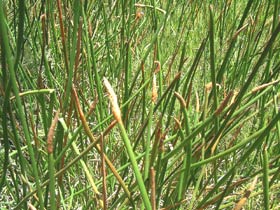
Photographer: John Smith-Dodsworth, Licence: CC BY-NC
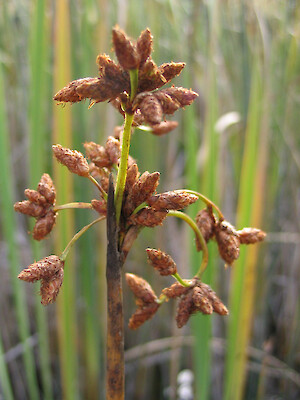
Photographer: John Barkla, Licence: CC BY
In 1905 Elsdon Best wrote an article titled ‘Maori Eschatology: The Whare Potae (House of Mourning) and its Lore’. Within this he backed what Hamilton described in his pukapuka while also expanding slightly on the process. While both passages are lengthy and somewhat repetitive in terms of the mātauranga they share, I do believe it is important to see both recollections of the taonga these men observed during this era. Best wrote:
“The term “whare potae,” which is the form used by the Tuhoe Tribe is derived from the potae taua, or mourning-cap (perhaps more correctly a fillet or chaplet, inasmuch as it possessed no crown). This was an article of mourning attire, a token of mourning for the dead. It was worn in former times by a near relative of the deceased, as a widow, during the period of mourning. It is composed of a band or fillet woven from some fibre usually, and which is put around the head and tied at the back. It has no crown whatever. Attached to this band would be a quantity of black, dried seaweed, or the epidermis of a water plant or rush known as “kutakuta,” prepared as for a maro kuta,* and dyed black and brown, or left its natural colour of white and pale-yellow. These were attached by one end to the band and hung down, thus concealing the face and head of the wearer. Sometimes the tail-feathers (with skin attached) of the native pigeon, and those of the koko bird, were used to attach to the band. They swayed about when the wearer walked, or when affected by the wind.” (Best, 1905, p. 179).
Regardless of what materials were selected to create the pōtae, I think we can agree that a great deal of time and effort went into its’ creation. I can’t help but wonder if the time it took to prepare the various pieces of the pōtae was also a key part of the grieving process? If by taking the time to source the fibres, the feathers, the seaweed etc, you were allowing the body to process the mamae it was feeling. would that make the act of creating such a pōtae a manifestation of the grief the wearer was feeling? It could be its’ own tohu maumaharatanga. Its’ own reminder of the love, the longing, the connection the wearer felt for the deceased. A visible sign for those around you to know that you had suffered an unbearable loss and were in the midst of the grieving process. I wonder what extra care was taken by those around the mourner during these times.
There is a kōrero recorded in Sir George Grey’s ‘Polynesian Mythology, and Ancient Traditional History of the New Zealand Race’ that mentions Hine-i-te-iwaiwa wearing what could be interpreted as a pōtae taua. Here husband Tinirau was determined to seek utu for the death of his uri Tuwhakararo and sent her to find Whakatau-pōtiki. Whakatau was skilled in the art of war and enchantments and was deemed the best man for the job.
Once Hine-i-te-iwaiwa had found Whakatau and told him of their plight he urged her to do the following:
“Return at once and when you reach your village, give a great feast to the warriors; give them abundance of potted birds from the forests, but let all the oil in which the birds were preserved be kept for me; as for yourself, do not go to the feast, but, decking your head with a mourning dress of feathers, remain seated close in the house of mourning.” (Grey, 1855, p. 119).
It is somewhat comforting to see the existence of pōtae taua within our kōrero tuku iho. How the existence of this taonga that was seemingly never made to last has transported itself from the world of our tūpuna to right now.
Of course, just as pōtae taua live on within the our own kōrero and the writing of those early Pākehā scholars, they also live within John White’s novel ‘Revenge: A Love Tale of the Mount Eden Tribe’. In their thesis, Wallace suggests that the level of detail White uses could suggest that what he describes was something that he had seen himself or been told (Wallace, 2002, pg 108).
“…It had of course, been sacred, and had never previously been taken off the widow’s head, for such caps are usually allowed to wear away in the course of time after the days of mourning were over…” (White, 1940).
While we can never be truly certain if White’s description of a pōtae taua was 100% accurate, the imagery he created is simply beautiful. To start with a physical manifestation of grief with the creation of the pōtae taua and ending it with the feather and fibres wearing away to nothing as time slowly takes its toll on the wearer. What could be more beautiful than that?
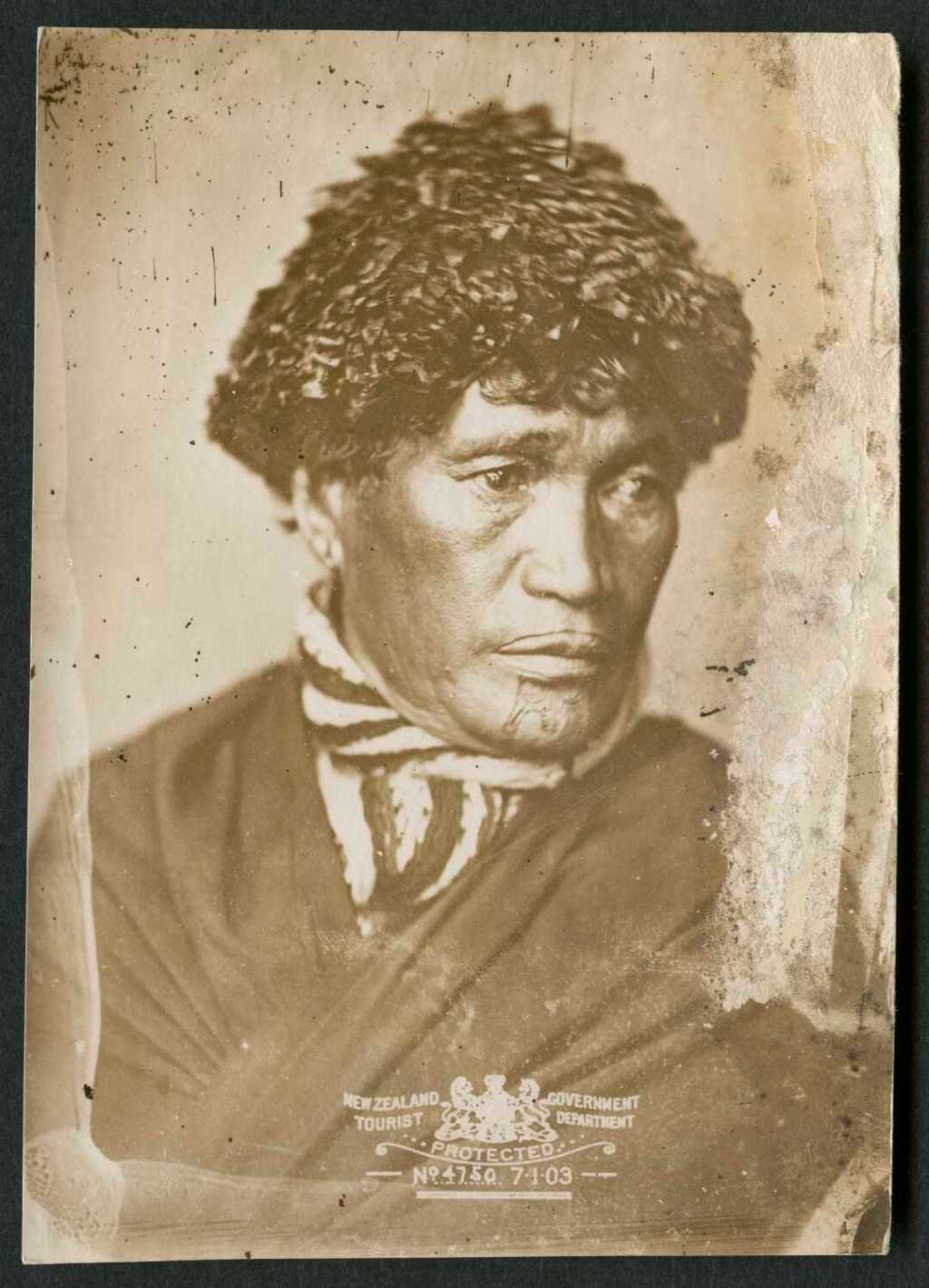
While browsing the National Library’s website I came across these two whakaahua. The first whakaahua shows an unidentified kuia who appears to be wearing a black feathered pōtae taua. According to the information provided the photo was taken sometime between 1880 and 1900. It is paired with the following description:
“Shows unidentified Maori widow. She is a kauae tehe, wearing a chin tattoo or moko kauae and a black potae taua or mourning cap on her head.” (National Library, n.d.)
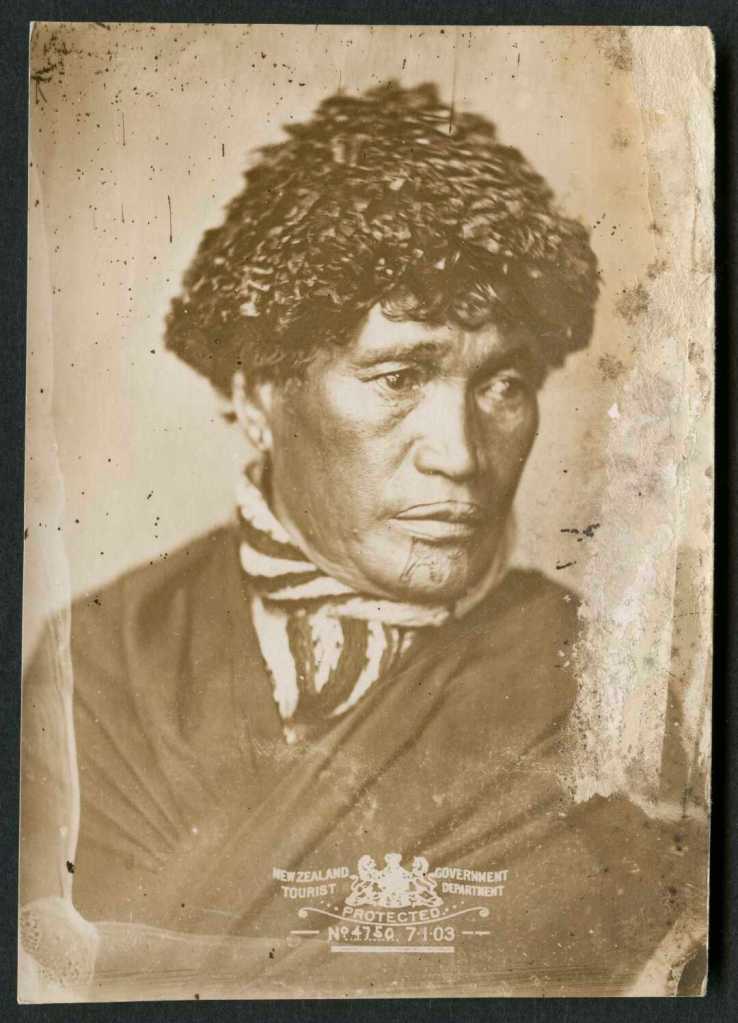
While it is such a taonga to have a picture of a kuia wearing a pōtae taua, the fact that she is relegated to simply “…unidentified Maori widow…” (National Library, n.d.) rubs me the wrong way. At the time it was taken, they took the time to pose her, photograph her and then presumably sell her image in the name of tourism. Yet her name was not recorded.
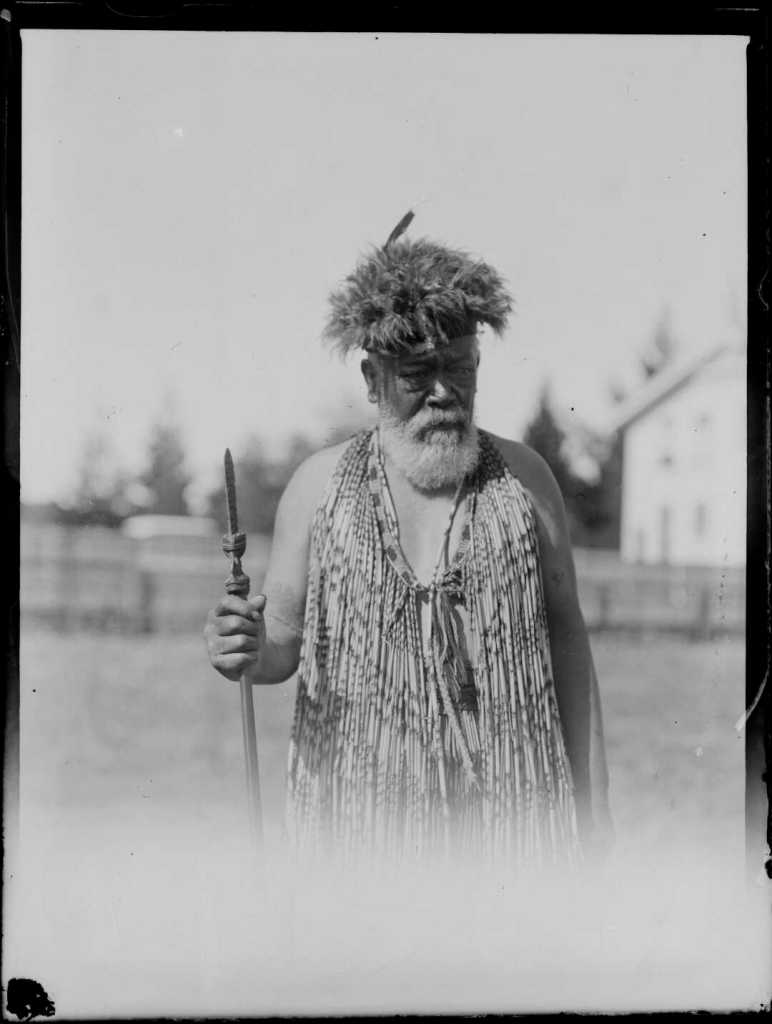
The second photo shows Tutanekai Haerehuka Taua of Te Arawa and was taken between 1925 and 1935. The National Library has the following description accompanying it:
“Photograph taken by Leo White showing Te Arawa kaumatua and tohunga Tutanekai Haerehuka Taua wearing a potae taua (kiwi feather headdress) and piupiu around his shoulders while standing holding a taiaha, probably in Rotorua.” (National Library, n.d.)
Of course, we will never be privy to the reason as to why both this kuia and Tutanekai were wearing their pōtae. We won’t know if they were actively grieving or if these photos were purely staged in the name of tourism. However, the mana of both individuals shine through in their respective photos. Like our kōrero, and the recordings and notes of those Pākehā scholars, these photos are tangible evidence that pōtae taua existed and had a role to play in Te Ao Māori.
While we sadly may never truly know the breadth and depth of the mātauranga that once surrounded pōtae taua, it is comforting to know that what we do know has so far survived the test of time. Mai te ao kohatu ki tēnei ao hurihuri, e ora tonu ana te mana o te pōtae taua.
– Stevie
References:
- Banks, J., Beaglehole, J. C., New Zealand Electronic Text Centre., & Trustees of the Public Library of New South Wales. (2008). The Endeavour journal of Joseph Banks 1768-1771. New Zealand Electronic Text Centre. http://nzetc.victoria.ac.nz/tm/scholarly/tei-Bea01Bank.html
- Best, E. (1999). Māori eschatology (Facsim. ed.). Kiwi.
- Grey, G. (1906). Polynesian mythology & ancient traditional history of the New Zealanders, as furnished by their priests and chiefs. Whitcombe & Tombs.
- Hamilton, A., & New Zealand Institute. (1972). Māori art. Holland Press.
- National Library. New Zealand Tourist-Department: Potrait of unidentified Maori widow with moko kauae and wearing a potae taua. https://natlib.govt.nz/records/22904182?search%5Bpath%5D=items&search%5Btext%5D=potae+taua
- National Library. Photograph of Tutanekai Haerehuka Taua of Te Arawa holding a taiaha, Rotorua. https://natlib.govt.nz/records/22318682?search%5Bpath%5D=items&search%5Btext%5D=potae+taua
- Riley, M. (2001). Māori bird lore : an introduction. Viking Sevenseas NZ Ltd.
- Wallace, P. (n.d.). Traditional Māori dress : rediscovering forgotten elements of pre-1820 practice : a thesis in fulfilment of the requirements for the degree of Doctor of Philosophy in Māori, University of Canterbury, New Zealand. Thesis (Ph. D.)–University of Canterbury, 2002.
- White, J., Reed, A. W., & Victoria University of Wellington. Library. (2014). Revenge : a love tale of the Mount Eden tribe (1st ed.). Victoria University of Wellington Library. http://nzetc.victoria.ac.nz/tm/scholarly/tei-WhiReve.html
 Whare Hurahura
Leave a comment